
Magoffin Deed Types Explained
Magoffin County does not record one single kind of deed. The county clerk's land-record catalog holds many instruments. Each type does a different job. A recorded instrument shows who signed, who received an interest, and the stated consideration. It also shows the source of title and the legal description of the tract. It can point to an older deed by book and page. A contract for deed, for instance, leaves title with the seller. The seller keeps it until the contract runs its course. A correction deed repairs an earlier instrument while keeping the same grantor and grantee. Knowing the type tells you what the paper actually did.
| Deed Type | What It Does | Common Use |
|---|---|---|
| General deed | Conveys the interest described in the signed instrument | Ordinary land transfers |
| Quitclaim deed | Passes whatever interest the grantor holds without adding a title promise | Family transfers or title cleanup |
| Contract for deed | Leaves title with the seller until the buyer completes the contract | Installment purchase |
| Correction deed | Corrects an earlier deed and cites the original record | Name or description correction |
| Executor or commissioner deed | Conveys land through an estate or court-authorized sale | Probate and judicial transfers |
Not every recorded paper conveys land. Mortgages secure debt. Releases discharge all or part of a mortgage or vendor lien. Easements grant a stated right to use land. Plats may map a subdivision, road, lot, or dedication. The clerk also indexes condominium deeds, master deeds, and restrictions. Powers of attorney, leases, trusts, and assignments appear in the index as well. Search Magoffin County deed records alongside those related categories. That way the chain is not reduced to sale documents alone.
Magoffin Deed Index Access
The Magoffin County land-record page lists computer-indexed records online and points to American Land Records. The county publishes no readable public search screen for that system. Its field labels and earliest year are not stated. Result limits, image access, account rules, and fees are not stated either. Do not assume the web index reaches the county's first deed book.
| Possible Search Key | Research Use | Portal Status |
|---|---|---|
| Grantor or seller | Find transfers out of a named owner | Expected, not rendered |
| Grantee or buyer | Find an owner's acquisition deed | Expected, not rendered |
| Recording date | Narrow an approximate transfer year | Expected, not rendered |
| Book/page or instrument | Retrieve a known reference | Expected, not rendered |
| Document type | Separate deeds from liens, plats, and releases | Options not rendered |
The dependable fallback is direct. Call the clerk at 606-349-2216 with exact party names, an approximate year, the address, and any known legal description. Ask whether a public counter terminal opens images or years the external site does not. A narrow written request under the Kentucky Open Records Act also works. Describe the names, date range, instrument types, and copy format you want.
Magoffin Deeds Need Land Clues
A street address is a lead, not the controlling land description. The clerk's official deed requirements demand a legal description and source of title. Parties and mailing addresses go in. A consideration statement and a preparation statement do too. A return address and acknowledged signatures round out the filing. The description may use metes and bounds or cite a subdivision lot and block. Older deeds may carry no modern road number at all.
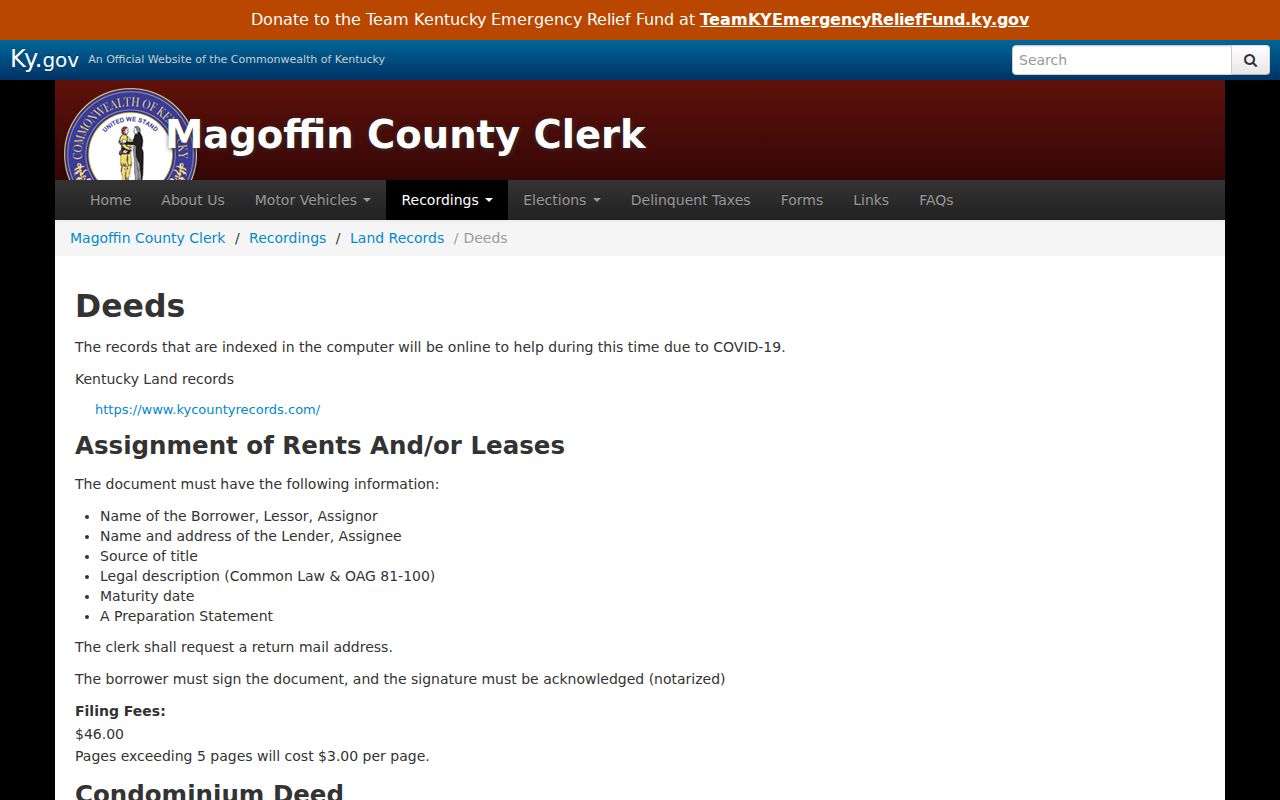
The county page supplies the filing checklist. Use it to compare an index lead with the full recorded instrument. Match the new instrument to its source deed. Then compare adjoining-owner calls, acreage, road or river references, reservations, and easements. A matching surname alone proves nothing. Parcel numbers can connect newer assessment material. But the deed's own description keeps the same tract in view.
Note: File a deed in the county where the property, or the greater part of it, lies under KRS 382.110.
Magoffin Grantor-Grantee Chain
The party roles create the chain. The grantor transfers the stated interest. The grantee receives it. Begin with the best-known recent owner as grantee, and read the acquisition deed for the prior owner, recording reference, source title, and legal description. Then switch roles and search that prior grantor as a grantee in an earlier period. Every sound link should concern the same tract and the same interest.
- Get the owner and parcel clues from the PVA office, or begin with a known deed reference.
- Search the owner as grantee and select the deed with the matching land description.
- Copy the grantor name, deed type, date, and book/page or instrument reference.
- Search that grantor as an earlier grantee, then repeat while each description remains consistent.
- Move to clerk books or KDLA material when the online trail stops.
- Grantor
- The party transferring the interest.
- Grantee
- The party receiving the interest.
- Chain of title
- The linked sequence of transfers affecting the same land.
- Book and page
- A volume-and-page locator for a recorded paper.
- Instrument number
- A distinct filing identifier used in some newer record systems.
Names shift through marriage, estates, initials, trusts, and business entities. Search variants in both roles, and for a fuller workflow beyond deeds, try the Magoffin County property search.
Magoffin Deeds Since 1860
The Kentucky Department for Libraries and Archives inventory lists Magoffin County deed records. The range covers 1860 through 2017. That range describes archival holdings, not an online start date and not a promise that every volume has been scanned. Magoffin County was formed in 1860. For a transfer before county formation, the KDLA land guide says to check the predecessor county. That is where the deed was first filed.
KDLA's deed research guidance recommends grantor and grantee indexes, deed books, and microfilm. Post-1890 deed references often point back to the prior book and page. Tax books can flag the years when a name appears. They also show when a name disappears while the deed chain is being tested. The clerk, KDLA, the Magoffin County Public Library, and cataloged FamilySearch films form the fallback chain. That chain works when the web link ends.
Coverage distinction. The 1860-2017 archival run is verified, but the earliest online index year and image depth were not established.
1957 Magoffin Record Question
KDLA's courthouse-disaster list places a disaster in Magoffin County in 1957. The entry names no event type. It also names no affected series. That means no deed, mortgage, will, tax, or order book is singled out. The silence matters. Claiming a fire destroyed a specific book would be guesswork. So would claiming the 1860 run survived untouched.
A broken chain near that era calls for comparison work. Set the clerk's present holdings beside the KDLA inventory, microfilm, reconstructed indexes, and predecessor-county books. Ask which volume fed the microfilm. Ask whether a replacement index exists. Treat the 1957 entry as a warning, not proof of a missing deed.
Magoffin Deeds and Encumbrances
One conveyance seldom settles every title question in Magoffin County. The clerk records mortgages and assignments. Releases, judgment liens, and mechanic's liens each get separate instruments. Lis pendens notices, restrictions, plats, and easements are recorded separately too. Search those entries against the same parties and the same legal description. A proper release cites its source mortgage or vendor lien. A proper assignment ties the original mortgage parties to a book and page. A lis pendens warns that a court action may affect title.
Estate transfers open a second paper trail. An executor or administrator deed should be read alongside the court appointment. The sale order that authorized it matters too. An affidavit of descent may name heirs. A commissioner deed may spring from a judicial sale. These deed records explain a common puzzle. One owner of record does not always trace back to a routine purchase deed.
Magoffin Deed Fees and Copies
The clerk's published recording-fee schedule lists a deed at $50 and a mortgage at $80. Assignments, correction deeds, restrictions, encumbrances, easement releases, liens, and most modifications carry a $46 charge. A certified copy costs $5. Certified deed copies add $0.50 per page beyond three pages. Deed filings past the standard five-page threshold add $3 per page. Fees can change. Confirm the total before sending payment.
Recording fees and web image fees are different things. The online deed records statement does not mention accounts. It says nothing about payment for web images either. Say whether a plain image or certified copy is needed. Give the book and page, or the party and date range. Then ask the clerk for delivery and payment instructions.
Magoffin Deed Portal Gap
The American Land Records landing page is the endpoint the county's online-record statement points to.

The service is real and reachable. Still, its searchable fields, local coverage dates, and deed-image availability all require confirmation from the clerk.
Requesting Magoffin Deed Copies
A strong copy request gives the clerk enough detail to isolate the right filing. Include grantor and grantee, an approximate recording year, the deed type, and a book/page or instrument number if known. Add the address and legal description. Ask about the online index first. Then ask about a public terminal, counter search, mail delivery, and the county's open-records request process. The Recording Division publishes both an inspection notice and a request form.
Match the copy type to its use. A plain copy may serve personal land history. A certified copy carries the clerk's certification and its published charge. Neither substitutes for a legal title examination. For old deed records, ask whether the book sits onsite, lives on microfilm, or should come from KDLA.
Recorded, not guaranteed. Magoffin County deed records show accepted filings. They do not establish that title is clear or rule out unrecorded interests.